
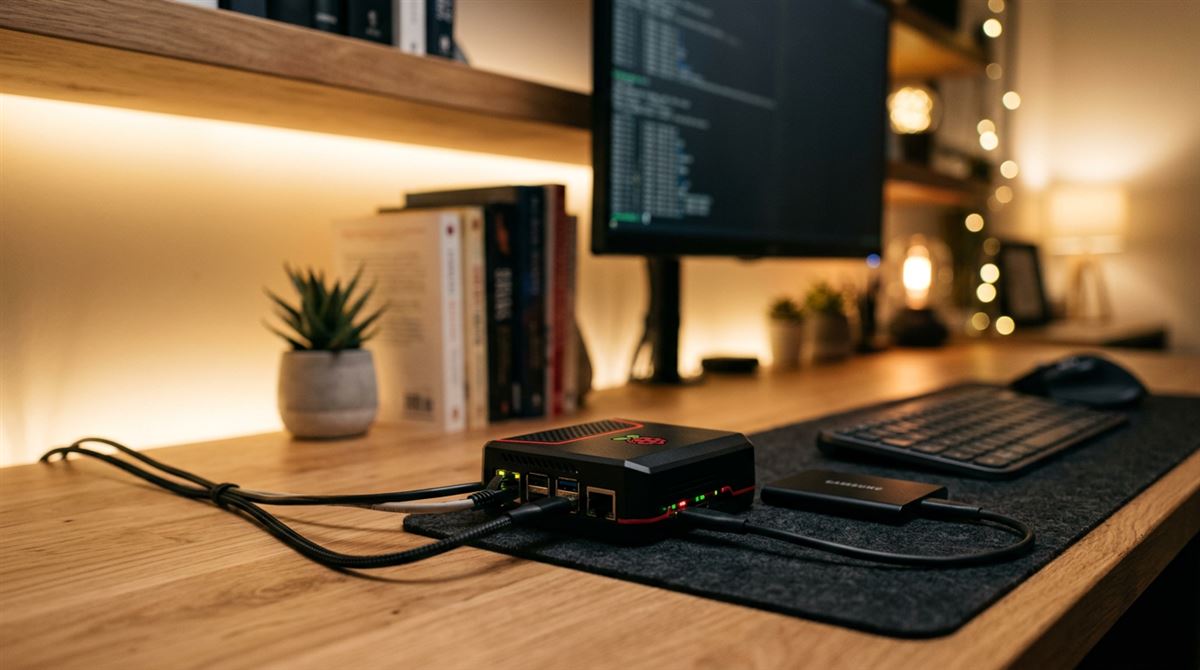
Full disclosure up front: my daily driver homelab box is a Raspberry Pi 4 Model B with 1 GB RAM (plus 1 GB swap), not the newer Pi 5. The backlog said “Pi 5,” but the honest review is the machine that actually runs my house. If you’re shopping today, a Pi 5 (often with more RAM) is the natural upgrade path—the ideas below still apply: small board, Docker, low power, and a household that cares about noise.
Why this little board exists
It sits under the desk so the status LEDs don’t audition for a disco. It runs 24/7. Power draw stays modest, and—important for domestic peace—it’s silent. My wife notices noise; she does not complain about the Pi. That alone is worth more than benchmark charts.
The rest of the setup is deliberately split: a router with Samba on a USB stick handles backups, and a small cloud VM hosts the portfolio site where I want availability without negotiating with the living room.
What actually runs on it
All in Docker—I want portability and rebuildability, not snowflake installs. Current cast of characters:
- MQTT — glue for sensors and automations
- MariaDB — relational data where SQLite would eventually pick a fight with me
- Home portal — our local dashboard / hub
- Redis — fast cache and small-service support
- Uptime Kuma — “is it up?” without pretending I’m a Fortune 500 NOC
- WordPress — because blogs refuse to write themselves
- Node-RED — integrations and quick wiring
That’s a lot of words for “single-user homelab.” It isn’t a data center. It’s a convenient one.
Performance: the surprise was RAM, not drama
With 1 GB RAM and swap, I expected constant suffering. Instead, everything fits for my workload, and CPU has been fine. I’m not compiling Chromium on it or running fifty Electron apps; I’m running services that mostly wait for the network and occasionally wake up to do something useful.
On storage religion: for a single-user homelab, I’m not losing sleep over USB vs NVMe theology. Pick something reliable, monitor disk, keep backups. The goal is services online, not forum arguments.
OS and orchestration choices
Raspberry Pi OS—boring on purpose. For orchestration I standardised on Docker. I flirted with Docker Swarm once; the setup overhead was more than my patience budget. Plain Compose-style flows won.
The honest reliability paragraph
It’s not immortal. I plan for at least one reboot a year as hygiene. Occasionally—rare enough to be annoying, common enough to mention—the Pi has frozen: temperature around 65 °C, system unresponsive. No active cooler on my unit; it hides under the desk and usually behaves. When it doesn’t, I treat it like any other small computer: reboot, check logs, move on.
Dust: a simple shell or enclosure helps. This is not aesthetic flex advice; it’s “fans and vents are filters if you’re not careful.”
Who should read this—and the verdict
If you’re a first homelab box shopper—or you think you need a $1,000 Mac mini before you’re “allowed” to self-host—you probably don’t. A ~$150 Raspberry Pi class machine, Docker, and patience will carry you for years at household scale.
Verdict: A+ for value. It’s an absolute banger for the buck. Upgrade to more RAM or a Pi 5 when your workloads say so; until then, ship services and stop deferring the lab on hardware perfectionism.
What’s your “too small to be serious” box that’s been serious anyway? I’m curious—especially if you’ve got a freeze story with a happier ending than mine.